

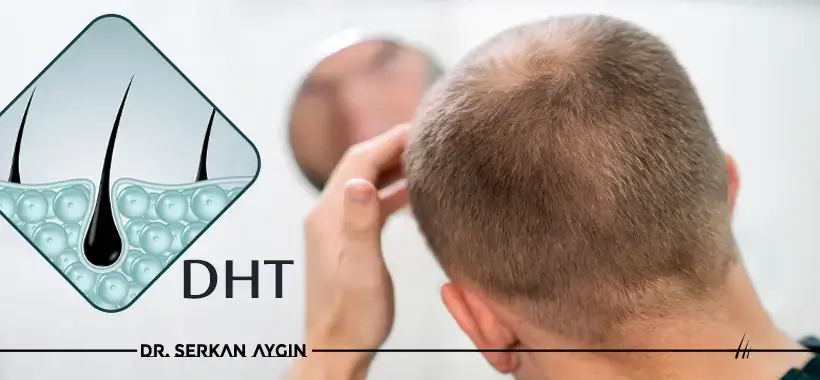
DHT and hair loss are closely linked in individuals with a genetic predisposition to androgenetic alopecia. In fact, dihydrotestosterone (DHT) is the primary hormonal driver of male pattern baldness. Understanding how DHT works—and how to manage its effects—is essential for slowing hair loss and preserving existing hair.
This guide explains what DHT is, how it affects hair follicles, how to confirm whether it is the cause of your hair loss, and which treatments are clinically effective.
What Is Dihydrotestosterone (DHT)?
Dihydrotestosterone (DHT) is a potent androgen hormone derived from testosterone. It plays a vital role in male development, beginning in the fetal stage and continuing through puberty and adulthood.
DHT is responsible for:
- Facial and body hair growth
- Deepening of the voice
- Development of the prostate and male genitalia
- Increased muscle mass
Despite its essential functions, DHT can have adverse effects on scalp hair in genetically susceptible individuals.
How Is DHT Produced? The Link with Testosterone
Approximately 10% of circulating testosterone is converted into DHT each day. This conversion occurs through the enzyme 5-alpha reductase, which is highly active in the scalp, prostate, and skin.
DHT binds more strongly to androgen receptors than testosterone—making it roughly five times more potent. This increased potency explains why even normal DHT levels can trigger hair loss in sensitive scalp follicles.
The Role of DHT Throughout Life
Puberty (Ages 11–18)
- Rapid increase in DHT levels
- Growth of facial and body hair
- Increased sebum production, often leading to acne or seborrheic dermatitis
Adulthood (Ages 19–40)
- Maintenance of facial and body hair
- Potential trigger for androgenetic alopecia in genetically predisposed individuals
Effects of Abnormal DHT Levels on Hair
When DHT Levels Are Too Low
Low DHT may result in:
- Sparse or absent facial and body hair
- Difficulty growing a beard or chest hair
When DHT Levels Are Too High
Excess DHT can cause:
- Progressive hair miniaturization on the scalp
- Receding hairline and crown thinning
- Accelerated progression of male pattern baldness
High DHT may also contribute to hyperandrogenic symptoms such as increased sweating, odor, and excessive body hair growth.
How DHT Causes Hair Loss (Androgenetic Alopecia)
DHT induces hair loss through a process called follicular miniaturization, which occurs in three stages:
- DHT binds to androgen receptors in susceptible hair follicles
- Hair follicles progressively shrink, producing thinner and weaker hair
- Hair growth eventually stops as follicles enter dormancy
Once follicles are fully inactive, natural regrowth is no longer possible.
Areas Most and Least Affected by DHT
|
Area of the Body |
Sensitivity to DHT |
Hair Loss Risk |
|
Frontal hairline |
High |
Very common |
|
Crown (vertex) |
High |
Very common |
|
Mid-scalp |
Moderate to high |
Common |
|
Back and sides of scalp |
Low |
Rare |
|
Beard and body hair |
Low |
Typically unaffected |
This difference explains why donor hair from the back and sides of the scalp is used in hair transplantation.
How to Know If DHT Is Causing Your Hair Loss
Key Clinical Signs
- Receding hairline and crown thinning
- Progressive miniaturization of hair shafts
- Preservation of hair on the sides and back of the scalp
- Oily scalp due to increased sebum production
Diagnostic Tests
A specialist may recommend:
- Scalp dermoscopy to assess miniaturized hairs
- Blood tests, including DHT, total testosterone, free testosterone
- 5-alpha reductase activity markers
- Thyroid panel, iron, and vitamin D levels to rule out other causes
Differentiating DHT Hair Loss from Other Conditions
|
Feature |
DHT-Related Hair Loss |
Other Hair Loss Types |
|
Pattern |
Temples and crown |
Diffuse or patchy |
|
Progression |
Gradual |
Sudden or episodic |
|
Scalp condition |
Normal or oily |
Inflamed or itchy |
|
Genetics |
Common |
Variable |
|
Reversibility |
Limited if advanced |
Often reversible |
How to Combat DHT-Related Hair Loss
Medical Treatments
- Finasteride: Reduces scalp DHT by approximately 70%
- Minoxidil: Improves blood flow and prolongs the growth phase
- PRP therapy: Delivers growth factors to follicles
- Low-level laser therapy (LLLT): Stimulates cellular activity
- Microneedling and mesotherapy: Support follicular regeneration
Natural DHT Modulators
- Saw palmetto
- Pumpkin seed oil
- Green tea extract (EGCG)
- Zinc and biotin
Natural options may help in early or mild cases but are generally insufficient for advanced hair loss.
Important Safety Considerations
Blocking DHT can cause side effects, including:
- Reduced libido
- Erectile dysfunction
- Mood changes, anxiety, or depression
- Fatigue and cognitive fog
Medical supervision and proper evaluation are essential before starting treatment.
When Hair Transplantation Becomes Necessary
In advanced stages of hair loss, medical treatments alone may no longer be effective. Hair transplantation becomes the most reliable solution when:
- Hair loss exceeds Norwood stage III–IV
- DHT blockers no longer maintain density
- Adequate donor hair is available in DHT-resistant areas
Modern techniques such as DHI and Sapphire FUE allow for natural, long-lasting results when performed by experienced surgeons.
Who Is Most at Risk for DHT-Related Hair Loss?
- Strong family history of baldness
- High DHT or testosterone levels
- Increased androgen receptor sensitivity
- Advancing age
- Hormonal imbalances
Hair Loss Types Not Caused by DHT
- Telogen effluvium
- Alopecia areata
- Fungal or inflammatory scalp conditions
- Traction alopecia
Accurate diagnosis is critical to avoid unnecessary or ineffective treatments.
FAQs
Does hair loss caused by DHT grow back?
Only in early stages. Once follicles are inactive, regrowth is no longer possible without transplantation.
How can DHT hair loss be treated effectively?
Through DHT blockers, minoxidil, PRP therapy, microneedling, and hair transplantation when necessary.
What causes elevated DHT levels?
Genetics, high testosterone, overactive 5-alpha reductase, anabolic steroid use, or hormonal imbalance.
How can I confirm DHT is the cause of my hair loss?
Characteristic hair loss pattern, family history, scalp examination, and hormone testing confirm the diagnosis.
Is blocking DHT harmful?
It can be effective but may cause side effects in some individuals, which is why medical supervision is essential.
Medical & Scientific References
- Sinclair R. Male androgenetic alopecia. BMJ. 1998.
- Kaufman KD. Androgen metabolism as it affects hair growth in androgenetic alopecia. Dermatologic Clinics.
- Trüeb RM. Molecular mechanisms of androgenetic alopecia. Experimental Gerontology.
- Olsen EA. Androgenetic alopecia: Pathogenesis and management. Journal of the American Academy of Dermatology.


