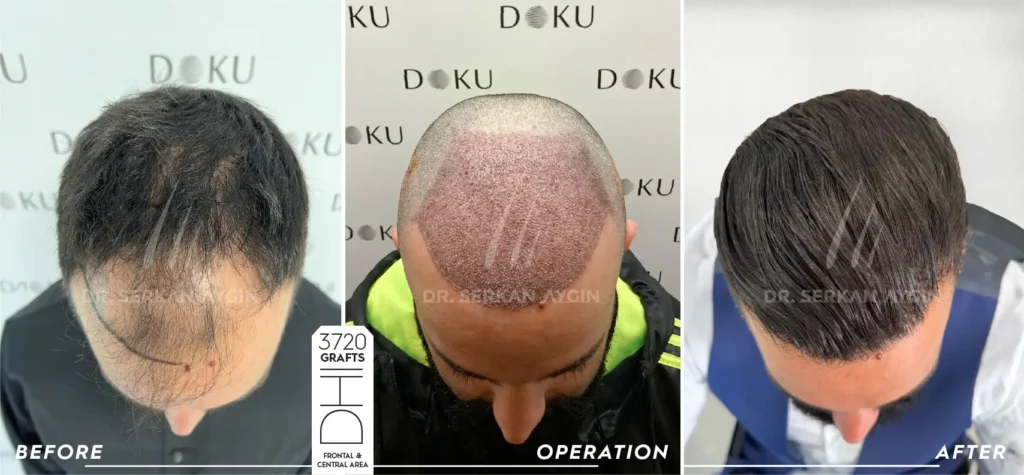

Watching your newly transplanted hair fall out after a restoration procedure can be alarming, but it is a completely natural part of the biological process known as shock loss. Typically occurring between months two and four, this temporary phase—often dubbed the ‘ugly duckling’ stage—is actually a good sign. It paves the way for new, permanent follicular growth. Here is everything you need to know to navigate this transition with confidence.
The Biology of Shock Loss: Why Does It Happen?
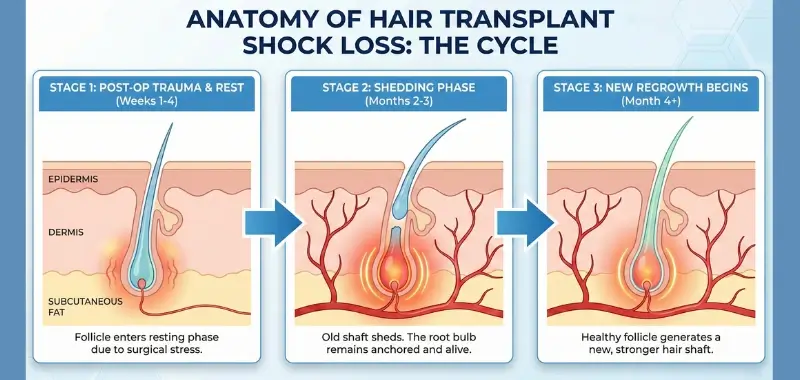
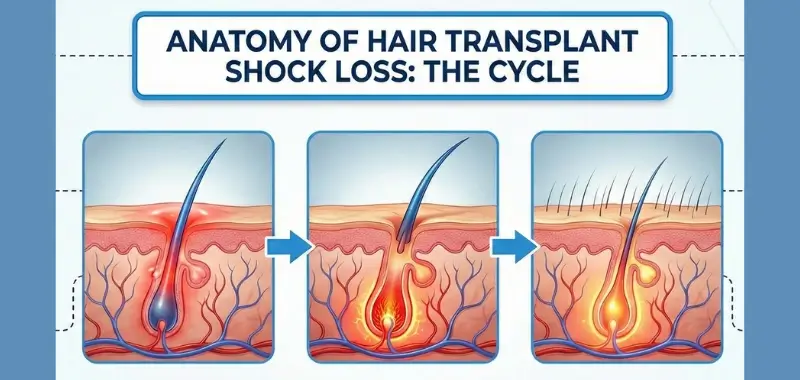
To make sense of why your newly implanted hair sheds, we need to look at the hair growth cycle. Shock loss is essentially a form of Telogen Effluvium triggered by the physical stress of surgery. When grafts are extracted and implanted, the follicles are temporarily cut off from their blood supply and oxygen. This trauma signals the follicles to prematurely enter the resting phase (Telogen).
As a result, the hair shaft detaches and falls out, but—and this is the key part—the root remains alive and securely anchored beneath the scalp. Think of this as a biological “system reset.” The follicle sheds the old structure to focus all its energy on generating a brand-new, robust hair shaft.
This phenomenon is universal. It doesn’t matter whether you undergo surgery at a local clinic or travel for a premium Hair Transplant procedure; the biological response remains the same. It is not a sign of failure or poor technique, but a physiological necessity for regeneration to begin.
The Shedding Timeline: Navigating Months 2-4
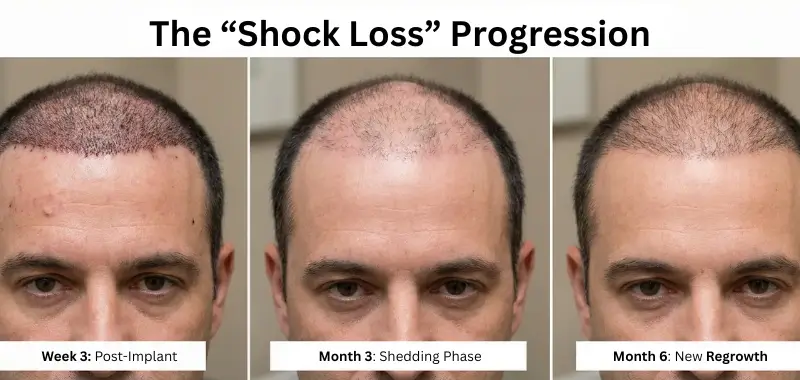
The weeks immediately following your procedure can be an emotional rollercoaster. At first, the transplanted grafts look like stubble, giving you an exciting glimpse of your future hairline. However, starting around week 3 to week 4, the shedding begins. This marks your entry into the “Ugly Duckling” phase, which can be psychologically challenging if you aren’t prepared.
Statistics show that approximately 95% of hair transplant patients experience shock loss to some degree. It is rare to skip this phase entirely. The shedding typically peaks during month 3, often leaving the recipient area looking sparse or patchy. While it may look like you’ve lost the grafts, remember: you have simply lost the visible hair shafts, not the follicles.
Table: The Recovery Phase Timeline – From Shock Loss to Regrowth
|
Phase |
Timeline |
Expected Activity |
|
Initial Growth |
Weeks 1-2 |
Grafts take root; hair appears as short stubble. |
|
Onset of Shock |
Weeks 3-4 |
Hair shafts begin to shed; you may notice hairs in the shower or on your pillow. |
|
Peak Shedding |
Months 2-3 |
The “Ugly Duckling” phase. Up to 80-90% of transplanted hairs may fall out. |
|
Dormancy |
Month 4 |
The scalp looks quiet; follicles are resting and recharging for the anagen (growth) phase. |
|
Early Regrowth |
Month 5+ |
Fine, new hairs finally begin to break through the surface. |
Types of Shock Loss: Native Hair vs. Transplanted Grafts
It is important to distinguish between the two types of shedding that can occur post-surgery. Most patients expect the transplanted grafts to fall out—that’s the standard process described above. However, some patients are surprised to see shedding of their native hair in or around the recipient area.
Native hair shock loss happens when existing follicles—which may already be weak due to genetic pattern baldness—react to the trauma of nearby surgical incisions. The inflammation caused by creating channels for new grafts can temporarily push these vulnerable native hairs into the resting phase.
The difference lies in the recovery. Transplanted hairs are genetically resistant to hair loss (DHT resistant) and are almost guaranteed to grow back stronger. Native hairs, provided they were healthy before surgery, will also return. However, if the native hairs were already at the end of their lifecycle or heavily miniaturized, they may require supportive medical therapy to bounce back.
Donor Area Shock Loss: Is It Permanent?
While most patients focus on the recipient area, donor area shock loss can also occur. This shows up as thinning patches on the back or sides of the head where grafts were extracted. Seeing this can be scary, leading patients to fear the surgeon has “over-harvested” the area.
In the vast majority of cases, this is simply temporary trauma. The extraction process creates thousands of tiny micro-wounds, and the scalp responds with inflammation, causing surrounding follicles to enter the Telogen phase. This type of shock loss typically resolves on its own, with hair density returning within 3 to 4 months.
That said, expertise matters. Choosing a reputable clinic is vital because skilled surgeons strictly monitor the extraction ratio to ensure the donor area isn’t depleted. If the donor area still looks patchy after 6 months, it may indicate over-harvesting—which is permanent—rather than simple shock loss.
Mitigation Strategies: Can You Prevent Post-Op Shedding?
While shock loss is biologically inevitable for most, you can often manage its severity and duration with the right approach. Minimizing trauma is key, which is where the choice of surgical technique plays a massive role. Advanced methods like Sapphire FUE and DHI (Direct Hair Implantation) utilize much sharper, finer blades than traditional steel scalpels. This precision significantly reduces vascular damage, potentially lowering the intensity of the shedding phase.
Although advanced techniques may slightly influence the Hair Transplant Cost, the investment often pays off with faster recovery rates and better preservation of native hair. Beyond the surgery itself, pharmacological support is essential. Many surgeons recommend a regimen of Finasteride and Minoxidil post-surgery.
Finasteride acts as a shield, blocking DHT to protect miniaturized native hairs from falling out due to stress. Minoxidil, a vasodilator, increases blood flow to the follicles, which can shorten the resting phase and encourage new grafts to enter the growth (anagen) phase sooner. Additionally, PRP (Platelet-Rich Plasma) therapy is frequently used to boost tissue repair and wake up inactive follicles.
The Light at the End of the Tunnel: Real Expectations
Getting through months two to four requires patience and trust in the process. It is the “gap” where you might look worse before you look better. However, by Month 5, the magic begins. You will start to see fine, colorless hairs breaking through the scalp. Over the following months, these hairs will thicken, darken, and gain texture.
It is vital to keep realistic timelines in mind when looking at Hair Transplant Before and After photos. The impressive density you see in portfolios is typically the result of 12 to 18 months of growth. The shock loss phase is just the quiet foundation work required to support that future structure. Don’t judge your results by the mirror in Month 3; judge them by the density in Month 12.