

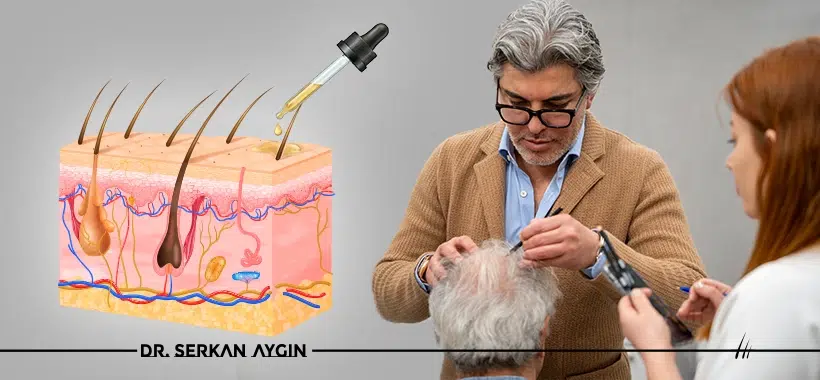
The search for a hair loss cure has often felt like a waiting game, but recent biotechnological advancements are bringing us closer than ever to a true solution. Among the most promising developments is a novel approach that looks beyond hormones to the very energy source of the hair follicle itself.
For decades, the science of hair loss has been stuck in a loop of hormones and blood flow. But a new contender, PP405 (also known as PP-405), is changing the conversation entirely. It’s not focusing on testosterone; it’s focusing on energy.
Developed by Pelage Pharmaceuticals, this investigational topical drug represents a paradigm shift in treating androgenetic alopecia. Instead of just preserving hair, it aims to biologically force hair follicles to grow again.
In Part 1 of our deep dive, we’ll explore the groundbreaking science behind PP405, how it “hacks” your cell’s metabolism, and why researchers believe it could be the biggest breakthrough since Minoxidil.
What Exactly Is PP405 and Why Is Everyone Talking About It?
To understand the hype, you first need to understand the failure of modern treatments. Most current drugs try to stop hair from falling out. PP405 is designed to make it start growing.
Quick Definition: A Mitochondrial Inhibitor, Not a Hormone
PP405 is a topical small-molecule drug designed to reactivate dormant hair follicle stem cells. Unlike Finasteride, it is non-hormonal. It does not mess with your testosterone or DHT levels.
Instead, it works on a cellular level by inhibiting a specific transporter in your cells’ mitochondria (the power plant of the cell). By tweaking how your hair cells process energy, it flips a biological switch from “rest” to “growth.”
The Origin Story: From UCLA Labs to Pelage Pharmaceuticals
This discovery wasn’t an accident. The science is rooted in years of rigorous research at the University of California, Los Angeles (UCLA).
The foundational work was led by scientists Bill Lowry, Heather Christofk, and Mike Jung. They discovered that hair follicle stem cells (HFSCs) behave differently depending on what “fuel” they are burning. When they metabolize glucose into lactate, they grow. When they burn pyruvate, they rest.
Recognizing the potential to cure baldness, this technology was spun out into Pelage Pharmaceuticals, a company solely dedicated to translating this metabolic mechanism into a usable drug for humans.
The Mechanism of Action: “Hacking” Follicle Metabolism
This is where the science gets fascinating. If you’ve ever wondered why your hair stops growing, the answer might lie in your mitochondria.
The Problem of “Dormancy”: Your Follicles Aren’t Dead, Just Sleeping
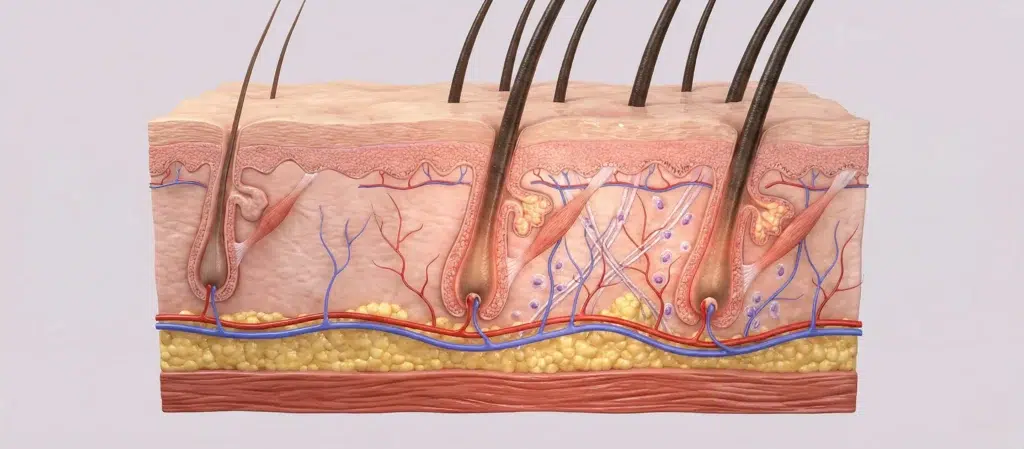
A common misconception about androgenetic alopecia (pattern baldness) is that the hair follicle dies and disappears. In reality, in the early and mid-stages of baldness, the follicle is still there—it’s just stuck in a comatose state known as the telogen phase (resting phase).
The stem cells required to grow new hair are present, but they have “forgotten” how to activate. They are dormant. PP405 acts as the alarm clock.
The Scientific Key: MPC Inhibition and the Lactate Effect
The mechanism of PP405 is precise. It acts as a Mitochondrial Pyruvate Carrier (MPC) inhibitor.
Here is the simplified biochemistry:
- Normal Function: Normally, cells transport pyruvate into the mitochondria to create energy.
- The Blockade: PP405 blocks this transport.
- The Pivot: Because the pyruvate cannot enter the mitochondria, the cell is forced to convert it into lactate (a process called increased lactate dehydrogenase activity).
- The Signal: Lactate is not just a waste product; it’s a powerful signaling molecule.
From Telogen to Anagen: Forcing the Growth Cycle
This surge in localized lactate production sends a chemical signal to the Hair Follicle Stem Cells (HFSCs). It tricks the cells into thinking the tissue is in a rapid growth state. This metabolic shift pushes the follicle out of the resting telogen phase and forces it into the anagen phase (active growth).
PP405 vs. Finasteride and Minoxidil: A Necessary Comparison
If you are reading this, you are likely already familiar with the “Big Two”: Minoxidil (Rogaine) and Finasteride (Propecia). To understand why PP405 is considered a game-changer, we have to look at how differently it behaves compared to the old guard.
Why PP405 Avoids the Sexual Side Effects of Finasteride
Finasteride works by inhibiting 5-alpha-reductase, the enzyme that converts testosterone into dihydrotestosterone (DHT). While effective, it is fundamentally a hormonal intervention. For many men, this comes with the dreaded risk of systemic side effects, including loss of libido and erectile dysfunction.
PP405 is non-hormonal. Because it targets the mitochondria inside the hair follicle rather than androgen receptors throughout the body, it does not lower your DHT levels. This makes it a potential “Holy Grail” for patients who are sensitive to Finasteride or simply refuse to mess with their hormones.
Key Differences in Delivery and Therapeutic Targets
- Minoxidil: Works as a vasodilator (opening blood vessels). It creates a better environment for hair, but it doesn’t necessarily “fix” the cellular machinery.
- Finasteride: Stops the damage (DHT) that shrinks the follicle. It is a shield, not a fertilizer.
- PP405: Acts as a direct metabolic switch. It forces the stem cells to wake up and proliferate.
The Chemistry Behind the Miracle: Small Molecules and Absorption
Why is PP405 applied as a gel and not taken as a pill? The answer lies in its chemistry and safety profile.
Formulation: 0.05% Topical Gel
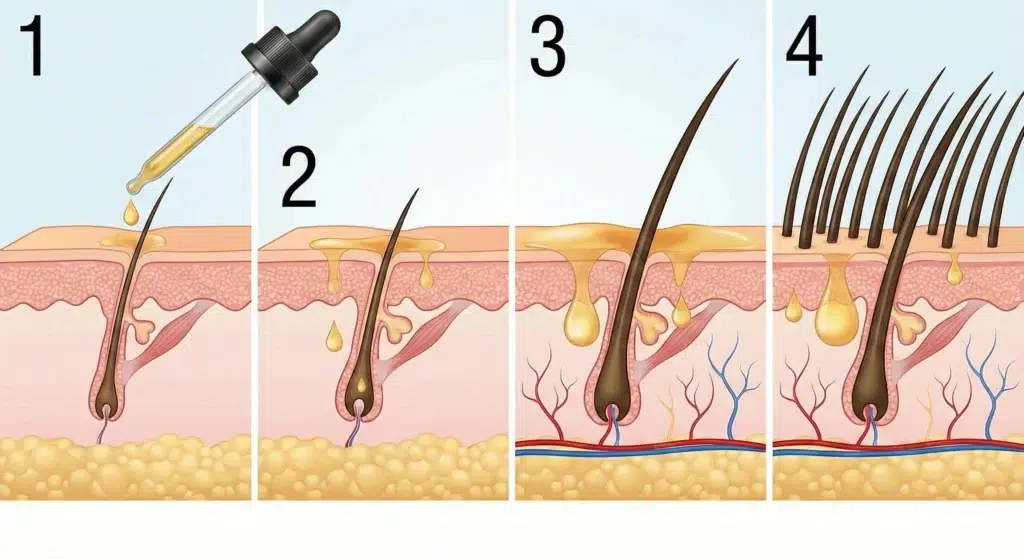
According to clinical trial data and public patent filings, the drug is being tested as a 0.05% topical small-molecule solution, applied once daily. The term “small molecule” is crucial—it means the chemical structure is tiny enough to penetrate the harsh barrier of the scalp and reach the follicle bulb without needing injections.
Why Topical? Safety First
Systemic absorption is the enemy of any good hair loss drug. You want the drug in your scalp, not in your bloodstream affecting your heart or liver.
Phase 1 trials proved that PP405 has a unique property: it binds effectively to the skin but is unstable in the blood. If any of the drug seeps into the bloodstream, it degrades quickly. This ensures the metabolic “hack” happens only where you want it—on your head.
Current Alternatives While We Wait for Science
Let’s be realistic: PP405 is likely 2 to 4 years away from your bathroom shelf. The FDA approval process is slow, and while 2027 is the optimistic target, your hair follicles are shedding today. Waiting for a miracle cure often means losing ground that cannot be recovered.
The Proven Solution: Surgery & Science Combined
You don’t need to wait for mitochondrial inhibitors to restore your hair. At the Dr. Serkan Aygin Clinic, we combine world-class surgical precision with advanced biotechnological support.
We are proud to be the premier destination for a Hair Transplant in Turkey, offering patients from around the world the highest standard of Sapphire FUE and DHI restoration. Unlike experimental drugs, this procedure physically relocates healthy follicles to thinning areas for permanent results.
To protect your existing hair and enhance your transplant results, we utilize MDBio. Much like the concept behind PP405, MDBio is our proprietary complex designed to deliver potent growth factors, vitamins, and peptides directly to the follicle root. It acts as a bridge between surgery and biology, strengthening the hair life cycle today without waiting for future drug approvals.


