

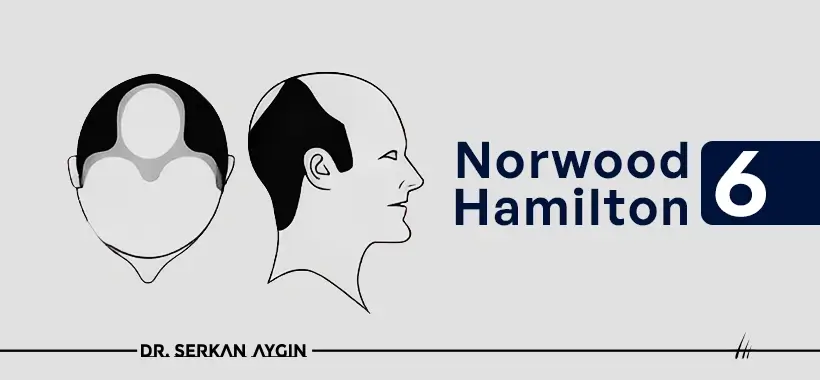
Reaching Norwood Scale Stage 6 often feels like the end of the road for hair restoration. At this stage, the “bridge” of hair that once separated the front from the crown has completely disappeared, leaving a single, continuous area of baldness that spans the entire top of the scalp. The hair remaining on the sides and back usually forms a low “horseshoe” pattern.
Many men assume this level of hair loss is irreversible. However, while Stage 6 presents a significant surgical challenge, it is not impossible to treat. With a strategic approach, advanced “mega-sessions,” and the intelligent use of supplementary donor sources, skilled surgeons can still restore a hairline that frames the face and takes years off your appearance.
Defining the Challenge: What is Norwood Stage 6?
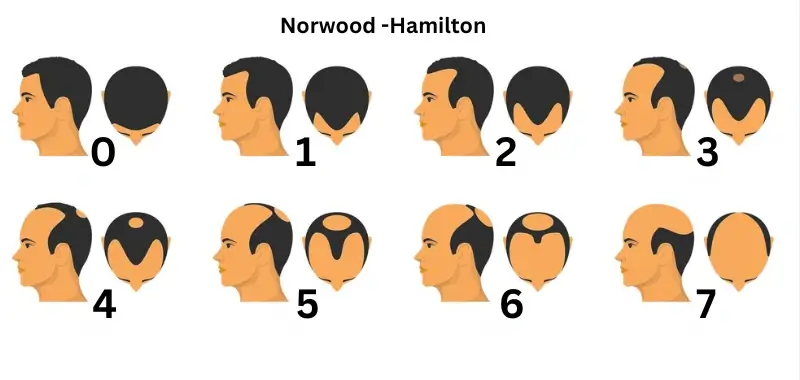
To treat the problem, we must first define it. The Norwood Hamilton Scale helps surgeons classify the extent of balding. Norwood Stage 6 is distinguished by the merging of the frontal and vertex (crown) bald zones.
The primary challenge at this stage is the Supply vs. Demand Ratio. The area requiring coverage is vast, but the donor area (the safe zone at the back) is smaller than in earlier stages. Therefore, a Hair Transplant Turkey procedure for Stage 6 is less about “restoring original density” and more about “strategic illusion”—creating maximum visual impact with finite resources.
The Strategy: How Many Grafts Are Needed?
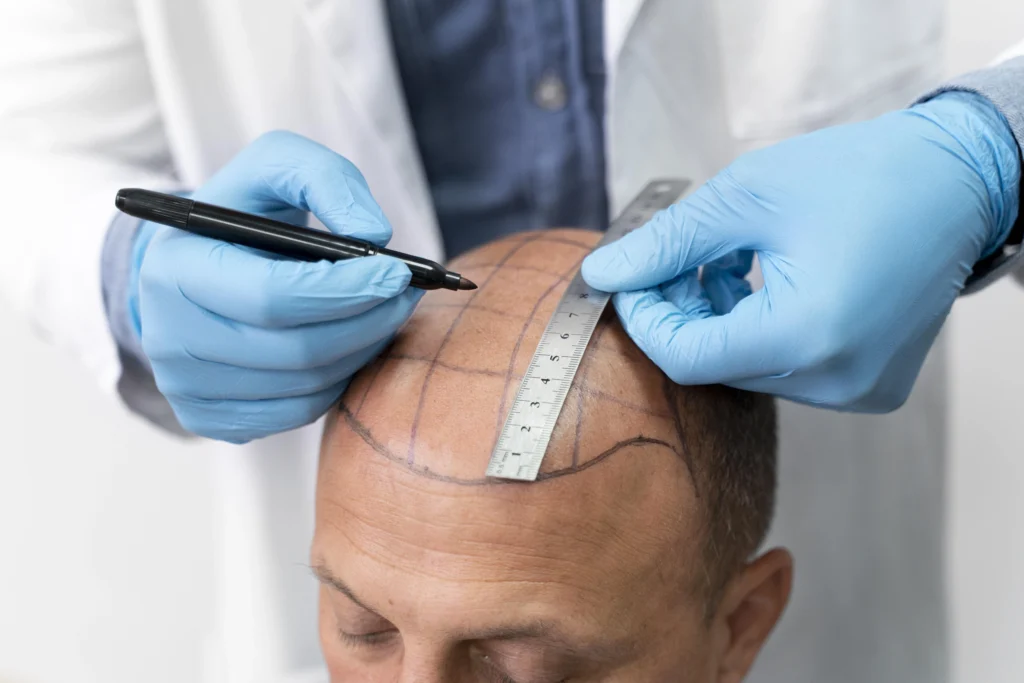
For a Norwood Class 6 patient, the concept of a “standard” hair transplant does not apply. We are looking at a total reconstruction.
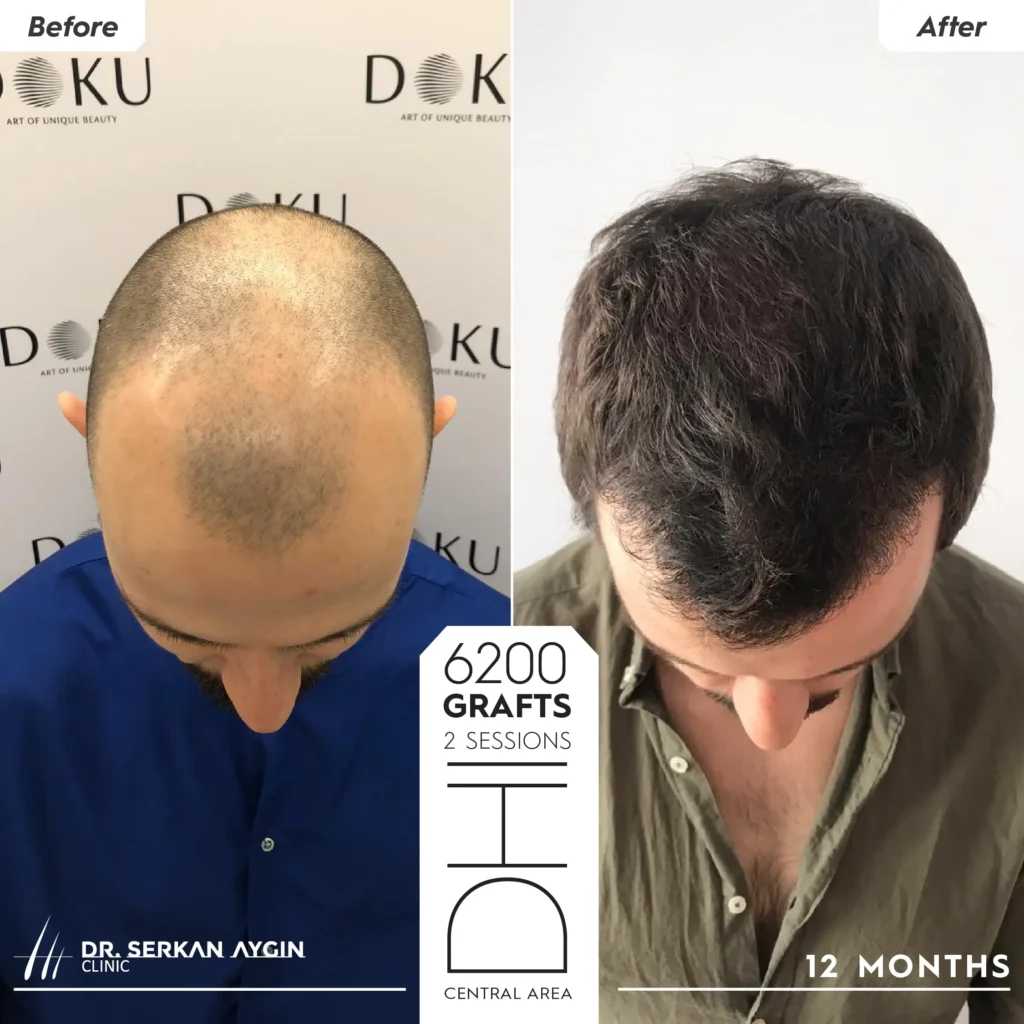
To achieve significant coverage, the requirement typically ranges from 5,000 to 7,000 grafts. Since harvesting this amount in a single day can be unsafe for the donor area (risking over-harvesting or necrosis), surgeons often split the treatment into two separate sessions:
- Session 1 (Frontal Zone): Focuses on building a strong, dense hairline and mid-scalp coverage (approx. 3,500–4,000 grafts). This frames the face and makes the patient look younger immediately.
- Session 2 (Crown/Vertex): Performed 8–12 months later to fill in the back area (approx. 2,000–3,000 grafts).
Graft Estimation by Norwood Stage
The table below highlights the dramatic increase in graft needs for Stage 6 compared to earlier stages.
Norwood Stage | Hair Loss Pattern | Estimated Grafts Needed |
Stage 4 | Solid bridge exists | 3,000 – 4,000 |
Stage 5 | Bridge breaking down | 3,500 – 4,500 |
Stage 6 | Bridge gone, single large area | 5,000 – 7,000 (Two Sessions likely) |
Stage 7 | Thinning of the horseshoe sides | Limited candidates (Consultation needed) |
Advanced Techniques: Combining Scalp and Body Hair
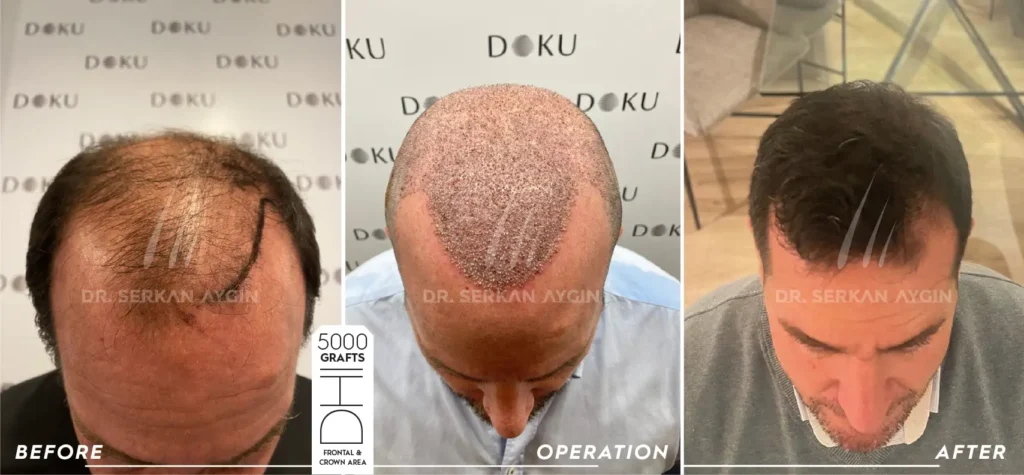
When the donor supply on the back of the head is insufficient to cover the entire bald area, top-tier clinics employ a Combined Technique. This involves using Sapphire FUE to harvest scalp hair for the hairline (where texture match is critical) and extracting Beard Grafts for density in the mid-scalp and crown.
Beard hair is thicker and coarser than scalp hair, making it an excellent “filler” material. By mixing beard grafts between scalp grafts, surgeons can boost the visual volume without depleting the back of the head. This technique is often the game-changer that makes a Norwood 6 restoration possible.
The Cost Equation: Why Turkey is the Smart Choice
In the US or UK, a multi-stage restoration requiring 6,000+ grafts could easily cost $25,000 to $35,000. Most clinics charge per graft, making extensive hair loss financially punishing to treat.
Conversely, the Hair Transplant Cost in Turkey remains accessible because clinics operate on “all-inclusive package” models rather than per-graft fees. A comprehensive plan, even if it involves two sessions or body hair extraction, is significantly more affordable—typically ranging from €3,000 to €5,000 total (depending on whether one or two visits are booked). This makes high-volume restoration financially viable for the average patient.
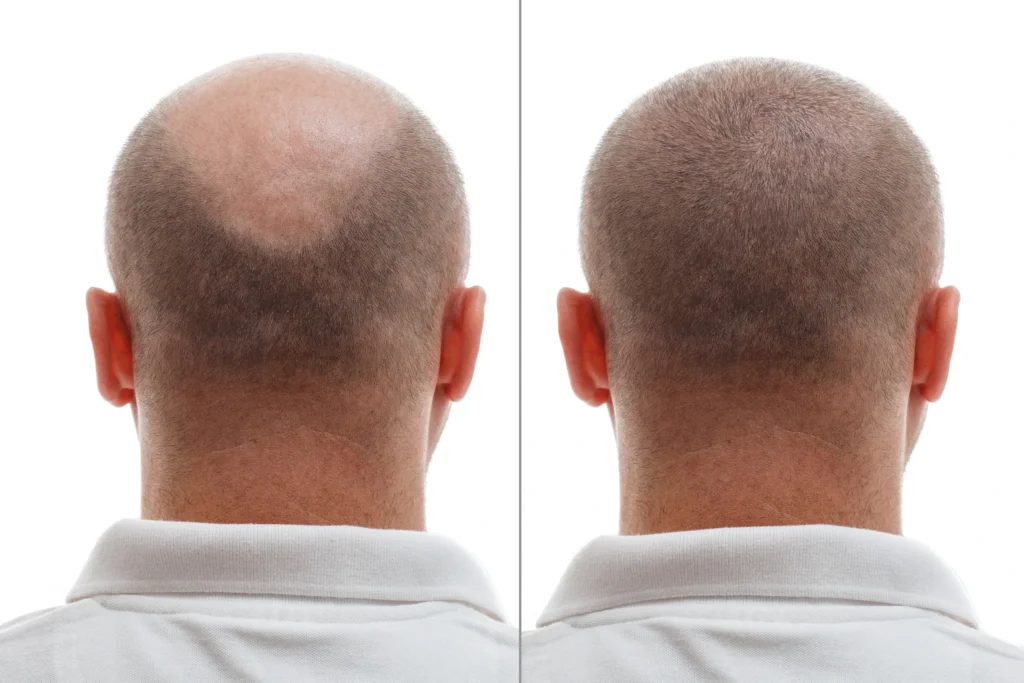
Realistic Expectations: Hair Transplant Before and After
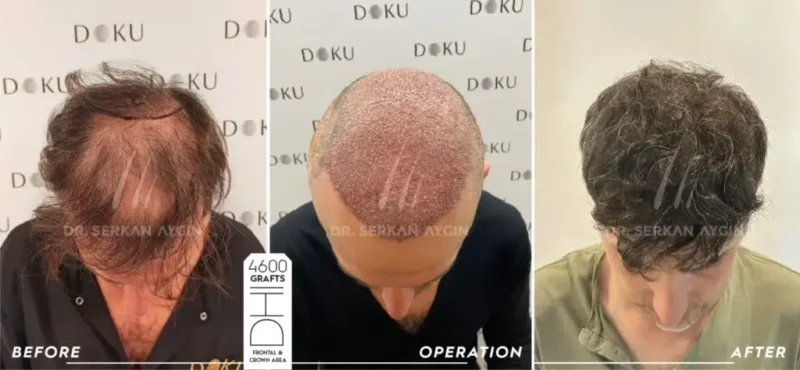
Managing expectations is vital. A Norwood 6 patient should not expect the density of a teenager. The goal is Coverage and Framing.
When looking at Hair Transplant Before and After photos for this stage, look at the hairline design. A well-executed transplant will frame the face perfectly, allowing the patient to look excellent from the front and profile views. The crown may remain slightly lighter (less dense) than the front, which mimics a natural aging pattern and ensures the donor area isn’t over-harvested.
Phases of the Process
Phase 1: The Foundation (Session 1)
- Goal: Establish the hairline and frontal coverage.
- Grafts: ~3,500–4,000 (Scalp + potentially Beard).
- Result: By Month 12, the face is framed, and the “bald look” is gone from the front view.
Phase 2: The Intermission (Months 1–11)
- Healing: The donor area regenerates and recovers shock loss.
- Assessment: The surgeon evaluates donor capacity for the second round.
Phase 3: The Completion (Session 2 – Month 12+)
- Goal: Fill the crown (vertex) and add density to the bridge.
- Grafts: ~2,000–2,500.
- Technique: Careful placement to blend with Phase 1 results.
Phase 4: The Final Look (Month 18–24)
- Outcome: Complete front-to-back coverage.
- Style: Patient can wear hair short or styled back with full confidence.
Don’t Assume It’s Too Late
 Being a Norwood Stage 6 does not mean you have to accept baldness. It simply means you need a smarter, more experienced surgical team. With the right plan, we can turn back the clock and restore your frame.
At Dr. Serkan Aygin Clinic, we specialize in complex, high-graft cases using advanced body hair extraction and Sapphire techniques.


